
In today’s rapidly evolving business landscape, companies face a constant barrage of challenges. From disruptive technologies to ever-shifting consumer preferences, traditional problem-solving methods often fall short. This is where creative problem solving (CPS) steps in as a powerful weapon for businesses seeking to thrive in uncertainty.
To address these challenges, modern management institutes are evolving to equip young professionals with creative problem-solving skills. These skills are crucial for running businesses efficiently while addressing the needs of all stakeholders, including co-workers, customers, partners, and vendors. Conventional problem-solving and decision-making relied heavily on analytical abilities, where solutions were derived based on facts, figures, and logical thinking. However, with each passing day, businesses encounter unprecedented situations that require creative thinking and problem-solving skills.
Traditional problem-solving approaches depend on data trends and use the past to predict probable outcomes. However, businesses today face unique challenges that lack historical precedents, necessitating innovative solutions. Creative thinking is becoming increasingly important as the business world seeks solutions to problems with complex or abstract elements. These types of problems lack defined paths or answers that apply universally, making the generation of creative ideas essential. Even in functional areas not typically associated with creativity, like finance, sales, and operations, creativity opens the door to radical approaches and solutions that conventional tactics struggle to address.
Creative problem solving (CPS) is a structured, process-driven method for solving problems and identifying opportunities. Formalised by Alex Osborn and Sidney Parnes, CPS uses creativity to encourage fresh perspectives in the decision-making process. CPS builds on the premise that:
Creative problem solving is a form of intentional creativity used to find solutions beyond conventional thinking. Osborn’s concept was studied extensively by Sidney Parnes, Ruth Noller, and their colleagues, who concluded that CPS can be taught and improve how people think and solve problems. By fostering creativity, CPS helps individuals and organisations break free from traditional problem-solving constraints and explore new possibilities.
Here’s why Creative problem solving (CPS) is a critical skill for modern businesses:
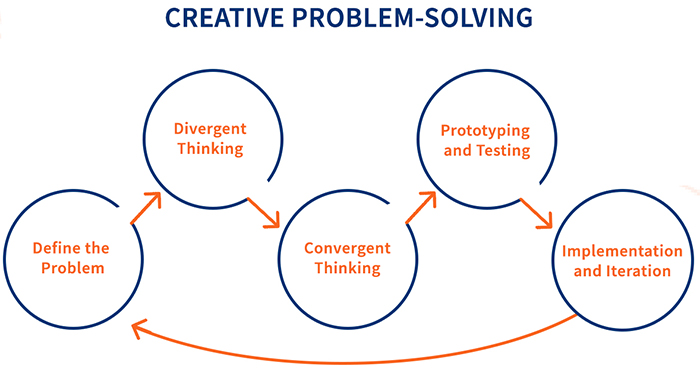
The Creative problem solving (CPS) process provides a framework for tackling challenges with a structured approach that encourages divergent thinking. Here’s a breakdown of the five key stages:
The foundation of any solution lies in a clear understanding of the problem. This involves identifying the core issue, gathering relevant information, and defining the desired outcome. Ask yourself: What are we trying to achieve? What are the roadblocks hindering progress?
This is where you unleash your creativity! Brainstorm a wide range of ideas, no matter how unconventional they may seem. Techniques like mind mapping, freewriting, and role-playing can help generate diverse perspectives.
Once you have a pool of ideas, it’s time to analyse and evaluate them critically. Consider the feasibility, effectiveness, and potential impact of each solution. Here, techniques like SWOT analysis or creating a decision matrix can be helpful.
Don’t get stuck in the theoretical realm. Develop a prototype or a scaled-down version of your chosen solution. This allows you to test its effectiveness and identify areas for improvement before full-scale implementation.
Even the best plans might need adjustments. Implement your solution while monitoring its performance. Be open to feedback and iterate as needed. Remember, creative problem-solving is an ongoing process, not a one-time event.

Before 2014, Walmart struggled with numerous challenges, including a weak patent portfolio, increasing IP litigations, and financial difficulties. The retailer needed a significant transformation to stay competitive, especially against rivals like Amazon.
Walmart embarked on a comprehensive innovation strategy focusing on emerging technologies and strategic acquisitions. The company’s approach included:
Walmart’s creative problem-solving through technological innovation and strategic acquisitions led to several positive outcomes:
Walmart’s shift to a tech-centric approach and its strategic acquisitions exemplify creative problem-solving in action. By integrating emerging technologies and building a strong patent portfolio, Walmart successfully navigated its challenges and reinforced its market leadership.
Reference: https://www.greyb.com/blog/walmart-strategy/
The more you practise, the better you become at creative problem-solving. Here are some tips to enhance your skills:
In today’s competitive business environment, the ability to think creatively is a highly sought-after skill for managers. By equipping themselves with Creative problem solving, management students gain valuable advantages:
At Badruka School of Management (BSM), we recognize the pivotal role of creative problem-solving in modern business success. Our two-year PGDM program, a premier AICTE-approved course in Hyderabad, designed to equip students with the skills needed to navigate today’s dynamic business landscape.
Our PGDM curriculum integrates core management courses with innovative elements such as Design Thinking, Leadership, and Digital Business strategies in the first year. This approach ensures that our graduates are well-prepared to tackle real-world challenges with creative and effective solutions.
Specialisations in the second year include Finance, Marketing, Innovation & Entrepreneurship, Data Analytics & Digital Technologies all infused with the latest industry insights. Short-term courses in Essential Skills and Perspectives further enhance our students’ critical thinking and industry knowhow, optimising their overall education.
Creative problem-solving is not just a skill – it’s a mindset shift. By embracing CPS, businesses can unlock their creative potential, overcome challenges, and achieve sustainable success in a rapidly changing world. Are you ready to hone your problem solving skills and become a future-ready leader? Explore innovative programs like those offered by Badruka School of Management (BSM), which integrate Design Thinking and CPS methodologies to equip students with the tools they need to thrive in the dynamic business landscape.



.svg)

.svg)