
In 2024, 23% of Harvard MBA graduates were jobless three months after finishing their degree. Chicago Booth’s unplaced rate jumped nearly sixfold from 2021 to 2024. Stanford’s tripled. Wharton’s the school that consistently tops every ranking you’ve ever seen more than doubled.
Let that sit for a moment.
These aren’t graduates from unknown institutions in tier-3 cities. These are people who paid upwards of $250,000 for two years at the most recognizable names in management education. And employers still looked at them and said: not quite ready.
Here’s the uncomfortable truth that those glossy brochures won’t tell you: a high-ranked B-school and a high-readiness B-school are not the same thing. And confusing the two is one of the most expensive mistakes a management aspirant can make in 2026.
So if rankings don’t reliably measure readiness — and the data says they don’t how do you evaluate a B-school? What do you actually look for?
This is that framework.
Start by understanding what rankings actually measure.
According to Poets & Quants, rankings are “lagging indicators with methodologies that weigh the wrong metrics.” The U.S. News methodology, for instance, gives 25% weight to peer and recruiter assessment scores essentially, how prestigious other deans think a school is. It has very little to say about whether a graduate can walk into a boardroom on Day One and actually contribute.
The result? Schools with strong legacies get rewarded for being strong legacies. And schools quietly doing the more important work redesigning how people learn don’t show up until years later, when their graduates outperform the field.
As one Harvard Business School career development official said plainly in 2025: “Going to Harvard is not going to be a differentiator. You have to have the skills.”
That’s the opening you need to hear before you look at any single ranking table again.
The real risk isn’t unemployment. It’s slow starts, mismatched skills, and lost compounding years. The Cengage Group’s 2025 Graduate Employability Report found that 48% of recent graduates felt unprepared to even apply for entry-level positions in their field and 56% of that group cited job-specific skills as their biggest gap. The degree wasn’t the problem. The design of how they learned was.
So here is what you should actually be looking at.
Picture this: it’s 9am on a Tuesday morning. You’re sitting in a Finance lecture. By Wednesday afternoon, you’ll be in an HR theory session. By Thursday, back to Finance except your brain has been somewhere else for 36 hours and has quietly forgotten most of what Monday taught you.
This is not a personal failing. It is cognitive science. Hermann Ebbinghaus documented it in 1885: within 24 hours of learning something new, the average person forgets approximately 70% of it. Without reinforcement, retention drops to 25% within a week. And yet the traditional model of 4 to 6 subjects simultaneously, over months is still the default for most B-schools.
Meanwhile, most workplaces don’t run on semesters. They run on sprints.
Executive education programmes at Harvard and INSEAD figured this out years ago: condensed, immersive, single-subject learning formats consistently produce better retention and faster application than the spread-thin semester model. Corporate L&D teams at companies like P&G, Unilever, and McKinsey run their internal development programmes the same way.
A B-school that runs on block-based teaching isn’t just making a scheduling choice it’s making a pedagogical one. It’s choosing depth over coverage, and execution over exposure. The question to ask any school you’re evaluating: does your curriculum structure reflect how real work actually gets done? Or does it reflect how a German research university in 1810 thought knowledge should be transferred?
Most B-schools update their core curriculum every few years. According to researchers at Poets & Quants, the reason is structural: “curriculum committee approvals, faculty consensus, and the willingness to retire courses that tenured professors built their careers on” make rapid change nearly impossible. They call the result “curriculum inertia” polished, credible-looking content that is quietly disconnected from what the job market actually needs right now.
In 2025, one MBA student documented spending hours manually mapping assumptions for a pricing strategy case. When she ran the same exercise through an AI tool, it generated twelve scenarios in four seconds. Her conclusion: “The assignment is teaching format, not judgment.”
A static syllabus teaches you how the world worked. A living curriculum evolves with it.
The test is simpler than it sounds: does the curriculum feel like a textbook or a dashboard? A textbook has chapters. A dashboard updates in real time. Ask any school you’re seriously considering: when was your last major curriculum revision? What triggered it? What did it change?
The answers will tell you more than any ranking table.
There’s a finding from IBM’s learning research that rarely makes it into B-school marketing material: content you only hear is retained at roughly 25% after 24 hours. Content you hear, see, and actively do is retained at over 90%.
Pause on that gap for a second. The difference between passive and active learning isn’t 10% or 20%. It’s the difference between remembering a quarter of what you were taught and remembering almost all of it.
Most lectures are designed to produce the 25% outcome. A student sits, listens, takes notes, and is assessed on recall. The problem is that management roles don’t require recall. They require judgment under ambiguity and you cannot build judgment by listening to someone else exercise theirs.
The shift that progressive programmes are making globally is from content delivery to consequence-based learning: simulations, casework, structured debate, and decision-making under pressure with real feedback. Yale SOM, for instance, now replaces traditional written case packets with “raw cases” multimedia environments with contradictory documents, competing stakeholder perspectives, and incomplete data that approximate how information actually arrives in the real world.
Managers don’t raise hands. They make judgment calls. The question is whether your B-school is training you to do the same.
Here is a structural truth that is almost never said directly: roughly 80–85% of faculty at top business schools in India have zero corporate experience. They are, as Dr. S. Arunachalam describes them, “pure play academics” experts in frameworks, but distant from the friction of using those frameworks under real conditions.
That gap matters more than it might seem.
Top global institutions recognised this years ago. INSEAD and MIT Sloan both operate dual-faculty models: academics who bring theoretical depth alongside practitioners who bring applied experience. The combination produces something neither can produce alone a classroom where the framework and the context for when it breaks down exist in the same room at the same time.
What this looks like in practice: Organisational Behaviour taught not by someone who has written about performance management, but by a Global L&D Head from P&G who has built performance frameworks across forty markets and watched them succeed and fail. Consumer Behaviour taught not as a chapter in a textbook, but by someone who ran consumer strategy at Standard Chartered. Entrepreneurship taught by the co-innovation lead from IIT-H, who has seen ideas fail in real time with real money on the line.
These aren’t guest lecturers. They teach full credit-bearing courses. They design assessments. They grade work. The grade a student receives comes from someone currently operating at the level that student is trying to reach.
As Dean Arunachalam puts it: “The line between campus and company should be porous.”
In an era where employers are specifically hiring for Day-One readiness, who is in the room when you learn is not a detail. It is a differentiator.
In 2025, Wharton launched an AI major with mandatory ethics courses. UVA Darden made an AI discussion platform a required component of its core strategy course. And McKinsey, long the benchmark destination for MBA graduates, now runs 25,000 AI agents alongside its 40,000 human employees, with those numbers expected to converge by the end of 2026.
The hiring data followed the same direction. McKinsey’s intake from Chicago Booth dropped from 71 students in 2023 to 33 in 2024. Amazon, Google, and Microsoft reduced their MBA hiring targets. The reason, per multiple economist analyses: companies were investing in AI and needed fewer junior employees doing the research and synthesis work that MBAs were historically hired to do.
The schools still adding AI as a standalone elective, as an opt-in module for 12% of students who choose it, are producing graduates who can talk about AI. That’s not the same as graduates who can think with it.
As the divide in management education sharpens, the real question for any school you evaluate isn’t “Is AI taught?” It’s: is AI embedded across how students learn, decide, and act? Does it appear in Finance, in Marketing, in Operations, in Strategy because that’s where it appears in the real world?
Prompt engineering in marketing. Autonomous agents in operations. AI-powered dashboards in strategy. No-code builds in finance. These aren’t futuristic additions. In 2026, they are the baseline of what a capable manager needs to be fluent in.
The test: ask any B-school you’re considering what percentage of their total learning hours involve AI tools not in a dedicated lab, but embedded into the core curriculum. The answer will tell you exactly where they stand.
The AACSB, the global accreditation body for business schools, has been documenting the shift in hiring assessment for years. What leading firms are now looking for isn’t the candidate who scored highest on a memory-based test. It’s the candidate who can, as AACSB Insights puts it, demonstrate “consequence literacy” the ability to anticipate second- and third-order effects of a decision, not just recommend the most elegant solution.
Google doesn’t interview for recall. Neither does McKinsey, Deloitte, or any of the firms that compete for management talent in 2026. They simulate problems. They watch how you think when you don’t know the answer. They look for portfolios, not transcripts.
A B-school that still assesses primarily through memory-based exams is training you for an interview format that no longer exists.
The better question: when a student finishes a course at the school you’re evaluating, what do they walk out with? A grade, or evidence? A transcript line, or something they built that demonstrates they can do the thing?
The distinction matters because what matters isn’t what you remember. It’s what you can prove.
There’s now a substantial body of research behind what learning scientists call “deep encoding” the difference between surface familiarity with a concept and genuine capability to apply it. And the consistent finding is that deep encoding requires three things the traditional semester model systematically denies: time, continuity, and the absence of competing demands on the same cognitive bandwidth.
Professor Sophie Leroy at the University of Minnesota introduced the concept of “attention residue” in 2009: when you switch from one task to another, part of your attention stays behind on the previous task. You are physically in a new lecture, cognitively still in the last one. In a semester juggling five subjects, this happens every single day by design.
Victoria University in Melbourne addressed this directly in 2018 by scrapping the semester for first-year students and moving to a block model: one subject at a time, studied intensively before the next begins. The results weren’t subtle. First-year fail rates dropped 41%. Pass rates climbed to 87%. By 2024, an independent review recommended full expansion of the model.
Deep-learning models used by INSEAD, Harvard Executive Education, and leading tech bootcamps all reflect the same principle: condensed, focused immersion produces better outcomes than distributed coverage.
The block structure one subject, thirty hours, fifteen days, full focus isn’t a scheduling preference. It’s an architectural decision about what conditions human capability actually requires. When you engage with one discipline every day, building on each session, applying concepts the same afternoon they’re introduced and returning the next morning with them still warm in working memory, something measurably different happens. Concepts stop feeling like isolated facts. They begin connecting into a system of thought.
No juggle. No bloat. Just learning designed for mastery.
Most B-schools bring industry in as decor. A guest lecture here, a panel there, a LinkedIn post about a CEO who visited campus. And students attend, nod, and leave with no more capability than they arrived with.
The shift that serious programmes are making globally is from visibility to utility. Yale SOM’s capstone projects embed students inside live business problems. SP Jain’s live labs put students in real client environments. The model is the same: the real world is not a guest. It’s the curriculum.
Recruiters have been clear about what they’re looking for: whether a candidate has solved a real business problem, not whether they attended a panel about one. The GMAC Corporate Recruiters Survey consistently identifies applied project experience as among the most valued signals a graduate can carry into a hiring conversation.
When the line between classroom and boardroom blurs when students are building bots and dashboards, co-leading institute projects, working with startups something shifts. The transition from student to contributor stops being a leap and starts being a continuation. And sometimes, performance becomes placement: a student selected by a faculty entrepreneur to join their live venture team, not after graduation, but because of what they built during it.
That’s not an outcome. That’s a design signal.
100% placement is a number. It tells you nothing about the quality of the roles, the speed at which graduates added value, or whether they needed six months of hand-holding before they could contribute independently.
The Cengage 2025 data is instructive here: 48% of graduates said they felt unprepared to even apply for entry-level jobs. 56% said their biggest gap was job-specific skills, the tools, workflows, and decision-making frameworks their employers expected them to show up with. Educators, by contrast, were 89% confident their students were ready.
That gap between how institutions perceive readiness and how graduates actually experience it is where the real evaluation question lives.
The better metrics aren’t placement percentages. They’re: what roles do graduates take, and how fast do they add value? Are students shifting from learner to contributor before they finish the programme or does that transition happen slowly, on the employer’s time and dime?
A programme that embeds live projects, real deliverables, and genuine business problems into its curriculum doesn’t just improve readiness. It compresses the timeline between graduation and meaningful contribution. Placement is a number. Readiness is a mindset and it’s built, not announced.
In 2012, Google ran one of the most comprehensive studies of team performance ever conducted. Project Aristotle, which analysed over 180 teams across hundreds of variables, arrived at a finding that surprised even its own researchers: who was on the team mattered far less than how the team worked together. And the single strongest predictor of team performance wasn’t IQ, credentials, or individual talent. It was psychological safety.
Teams where members felt safe to take risks, speak up, admit mistakes, and challenge ideas without fear of judgment consistently outperformed teams where that safety was absent on every metric that mattered: innovation, decision quality, productivity, long-term output.
The implications for a B-school culture are direct. An environment built on competitive pressure, public ranking systems, and individual evaluation produces a very specific kind of graduate: someone who has learned to protect information rather than share it, to perform confidence rather than develop it, and to optimise for looking good rather than getting better.
That’s not a management graduate. That’s someone who has survived a badly designed environment.
The environment you learn in for two years shapes how you collaborate for the next twenty. A B-school culture built on psychological safety, mentorship-led reflection, peer-led projects, and walk-in faculty access doesn’t just shape students. It compounds them.
What to look for in a B-School?
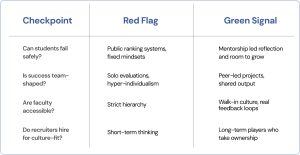
Design is the signal. It shows whether an institution knows where the world is headed or is still optimising for the world it was built in.
The best B-schools globally are doing the same thing: reverse-engineering their curricula from real role requirements rather than from tradition. They treat technology as a spinal cord, not a surface feature. They hire faculty for applied experience, not just academic publication records. They assess for capability, not recall. And their tone is grounded, not performative.
Employers don’t ask “What did you study?” They ask “Can you contribute in Week One?”
In a market full of loud promises, the schools worth attending build quietly and deliver consistently.
At BSM, every layer of design is deliberate.
AI is embedded, not optional. Faculty are operators, not theorists. Teaching runs on 15-day blocks: deep, focused, real. Students don’t memorize. They build. They don’t recite. They reason.
This is decision-first learning. Quiet, but built to work.
Forget vanity stats. Before you commit two years and a significant financial investment to any programme, ask the questions that rankings can’t answer:
The answers will either give you confidence or give you pause. Both are useful.
Most comparisons are outdated. Rankings can’t measure what matters. And a degree won’t make you a manager of a learning system.
Look under the hood:
Does the learning architecture match how real work gets done? Are students assessed in ways that mirror actual job decisions? Does the curriculum update fast enough to stay relevant? And critically who is in the room when you learn?
A programme that reverse-engineers its curriculum from real recruiter feedback, addresses the gaps between what graduates know and what employers actually need, and builds assessment around evidence rather than recall produces a specific kind of graduate: one who doesn’t need hand-holding on Day One. They just start solving.
Your B-school decision is a career decision. Choose the system that shapes how you think, build, and lead, not just how you pass.
Because smart learning isn’t about looking good on paper. It’s about becoming impossible to ignore in the room.



.svg)

.svg)