At some point in the last few months, you typed something like this into a search bar. Maybe it was late at night. Maybe you had seventeen tabs open. Maybe you had just gotten off a call with a parent who said “just do an MBA” and another with a friend who said “PGDM is better for placements” and you were no closer to knowing what was actually true.
Here is what nobody says plainly enough: this is not a small decision. Two years of your life. A significant financial investment. A programme that will either sharpen you for the market you are about to enter or leave you playing catch-up in your first role while your peers are already building things. The stakes are real. The confusion is understandable.
But here is the other thing nobody says plainly enough: the MBA vs PGDM debate, in its purest form, is the wrong question. The right question is this which programme is structurally designed for the job market of 2026, and which one is still optimising for a market that has already moved on?
That is what this piece is actually about.
An MBA, or Master of Business Administration, is a postgraduate degree conferred by a university or a university-affiliated institution. In India, MBA programmes operate under the governance framework of the University Grants Commission. The UGC sets the regulatory standards: what counts as an approved degree, what the minimum requirements are, and how academic changes must be processed.
That governance structure is the MBA’s defining feature in both directions. It provides something genuinely valuable: formal degree recognition that is broadly understood across employers, academic institutions, and, critically, public sector organisations and government roles where a degree designation often carries specific eligibility requirements. If your intended path runs through the civil services, a PSU career, academia, or research, the MBA’s degree status is not incidental. It is functionally important.
The trade-off is velocity. When a curriculum change needs to be made at a university-affiliated MBA programme, it typically moves through a formal review process: faculty committees, academic councils, university approval cycles. This is not a flaw in design so much as a structural reality of how large academic institutions govern themselves. The stability that makes the MBA credential durable is produced by the same architecture that makes rapid curriculum updates difficult.
For roles where the job description itself hasn’t changed much in ten years, that stability is a reasonable match. For roles being reshaped right now by AI, analytics, and automation, it begins to matter.
A PGDM, or Post Graduate Diploma in Management, is offered by autonomous institutions approved by the All India Council for Technical Education. The word “autonomous” is doing significant work in that sentence. PGDM institutions are not affiliated to a university. They design their own curriculum, set their own assessment architecture, and make their own decisions about faculty composition and pedagogy.
That autonomy was not an accident of history. PGDM institutions emerged specifically to address a gap that university-affiliated programmes couldn’t close fast enough: the growing distance between what industry needed and what academic governance could produce in time. The IIMs, XLRI, MDI, and SP Jain, several of India’s most respected management institutions, are autonomous PGDM providers, not university-degree programmes.
The word “diploma” still causes unnecessary confusion. In India’s private sector, where the overwhelming majority of management roles exist, the distinction between MBA degree and PGDM diploma has little practical weight in hiring decisions. As the Goa Institute of Management’s 2025 placement report illustrates, PGDM graduates from credible autonomous institutions are competing for and securing the same roles, at the same salary bands, as MBA graduates. What recruiters are evaluating, per GMAC’s 2025 Corporate Recruiters Survey of over 1,100 hiring managers across 46 countries, is skills, problem-solving ability, strategic thinking, and AI fluency, not the label on the certificate.
The difference between an MBA and a PGDM is not ideological. It is architectural. One is governed by a university and moves at the pace of academic consensus. The other is governed by its own institution and moves at the pace of the market it is trying to serve.
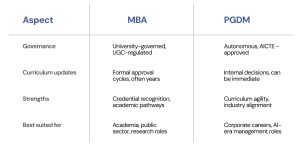
Neither is inherently superior. One prioritises continuity. The other prioritises responsiveness. The question is which one matches where you are going.
In 2025, a student documented spending hours manually mapping assumptions and drafting a memo for a pricing strategy case. An AI tool generated twelve scenarios in four seconds. Her conclusion was pointed: the assignment was teaching format, not judgment.
That moment captures what Trond Undheim at Poets & Quants calls “curriculum inertia” the condition where an institution’s content is academically coherent and practically disconnected at the same time. It happens when the approval cycles for curriculum change outlast the relevance of the content being changed.
The World Economic Forum’s Future of Jobs Report 2025, based on responses from over 1,000 global employers, found that 39% of current core skill sets will be transformed or obsolete by 2030. Not in a distant future. In four years. The curriculum being taught in 2026 needs to be preparing graduates for a market that will look meaningfully different by the time those graduates reach mid-career.
A PGDM programme with genuine institutional autonomy can respond to that rate of change. It can update a module because a recruiter said something important at a hiring conclave. It can embed a new tool because three GCC heads said it was now baseline expectation. It can retire a case study because the company it was built around no longer exists in the same form.
A static syllabus teaches you how the world worked. A living curriculum evolves with it.
Traditional management education was built on a model that made sense for its time: lectures, case discussions, written examinations. Students learn frameworks, analyse problems, and demonstrate understanding through recall under exam conditions.
The problem is not that this model is wrong. It is that it stops short of the thing employers actually need. IBM’s learning research puts the retention differential plainly: content you only hear is retained at roughly 25% after 24 hours. Content you hear, see, and actively do is retained at over 90%. And management roles don’t require 25% retention. They require judgment the ability to make a call when the data is incomplete, the timeline is short, and the consequences are real.
Globally, leading programmes are rebuilding around what some researchers call the “decision room” model. Yale SOM replaced its traditional written case packets with what it calls “raw cases”: multimedia environments with contradictory documents, incomplete financial data, and competing stakeholder perspectives that approximate how information actually arrives in the real world. Columbia Business School embedded an AI discussion platform across 3,000 students, requiring them to stress-test their arguments before class. The goal in both cases is not to teach a subject. It is to build the habit of reasoning under pressure.
Learning science supports the shift. The question for any programme you evaluate is not whether the content is comprehensive. It is whether the teaching method produces someone who can make a call in Week One.
Here is a structural fact about Indian management education that rarely appears in brochures: approximately 80 to 85% of faculty at top Indian business schools have zero corporate experience. They are, as Dr. S. Arunachalam describes, “pure play academics” well-equipped to teach frameworks, genuinely distant from the conditions under which those frameworks meet friction.
The global response to this has been what is increasingly called the pracademic model: full-credit courses designed and delivered by active industry practitioners, not as guest appearances but as the core teaching relationship. INSEAD and MIT Sloan have operated dual faculty models for years, blending academic rigour with practitioners who bring current tools, real constraints, and lived consequences into the classroom.
The distinction matters most in the specific content where it’s hardest to simulate: Organisational Behaviour taught by someone who has actually built performance frameworks across forty markets. Consumer Behaviour taught by someone who ran consumer strategy at a major bank and watched what happened when the framework met a real customer in a real market. Entrepreneurship taught by someone who has put real money behind real ideas and experienced real failure.
When the practitioner isn’t a visitor but the teacher when they design the assessment, determine the grade, and bring the texture of real decisions into every session the classroom changes. Not cosmetically. Structurally.
In July 2025, GMAC published its annual Corporate Recruiters Survey, drawing on responses from 1,108 hiring managers across 46 countries. The finding that dominated the analysis: AI fluency is now the single most important skill employers are hiring for in management graduates. Not a nice-to-have. Not a differentiator. The most important skill.
The same year, Wharton launched a dedicated AI major with mandatory ethics courses. UVA Darden made AI tools a required component of its core strategy course. McKinsey now runs 25,000 AI agents alongside its 40,000 human employees, with those numbers expected to converge by the end of 2026.
And yet, as researchers at Poets & Quants document, the vast majority of management programmes still treat AI as an elective, something a self-selecting 12% of students choose to take, in a dedicated module, separate from the core. These programmes are producing graduates who can talk about AI. That is not the same as graduates who can think with it.
The distinction that matters is between AI as a topic and AI as infrastructure. In the actual workplace in marketing, finance, operations, strategy AI is not a subject. It is the environment in which decisions get made. Prompt engineering sits inside marketing. Autonomous agents sit inside operations. AI-powered dashboards sit inside strategy. For a management graduate in 2026, fluency in these tools is not a specialisation. It is the baseline.
India’s AI transformation is not a future projection. ServiceNow’s AI Skills and Jobs Report identifies 2.73 million new tech jobs driven by AI transformation by 2028 in India alone. NASSCOM’s analysis is consistent: the bottleneck is not opportunity. It is readiness.
There is a finding from educational research that rarely makes it into management school marketing: students study what is tested. The assessment architecture of a programme reveals, more honestly than any brochure, what the programme actually values.
Memory-based examinations produce students who are excellent at recall under time pressure. That is a skill. It is just not a skill that appears anywhere in a modern management job description. Employers are not interviewing for recalls. They are assessing judgment, adaptability, structured reasoning under uncertainty, and the ability to deliver a real output with real constraints.
AACSB Insights documents this shift in how progressive programmes are rebuilding their assessment models: from static analysis to what they call “consequence literacy” the ability to anticipate second and third-order effects of a decision, not just recommend the most elegant solution. Across EMBA cohorts where assessment was redesigned around synthesising and critiquing AI outputs rather than passively using them, the results showed measurably higher critical application scores and stronger judgment skills.
The test for any programme you are evaluating is simple: when a student completes a course, what do they walk out with? A grade, or evidence? A transcript line, or something they built that demonstrates they can actually do the thing?
HR conclaves involving companies like Yes Bank and Darwinbox have surfaced the same pattern consistently: companies are experiencing what some recruiters now call “trainability fatigue.” Graduates arrive with strong academic records and limited practical toolkits. They understand frameworks. They need significant orientation before they can contribute independently.
The traditional progression runs: learner, then doer, then contributor. And in many cases, that journey takes two to three years in each stage meaning a graduate might spend the better part of a decade becoming fully productive in roles they were nominally qualified for on the day they graduated.
For employers, the biggest cost is not hiring. It is waiting.
This is particularly consequential in Hyderabad’s GCC ecosystem, which by 2025 housed 355 Global Capability Centers according to Zinnov’s Tier-I City Analysis Report, with five new ones being set up in Hyderabad alone as of mid-2025. India overall is home to over 1,700 GCCs, generating $64.6 billion in revenue and employing over 1.9 million professionals, per NASSCOM’s GCC analysis. These are not back-office operations anymore. They are value-creation hubs for the world’s largest companies Goldman Sachs, Microsoft, Amazon, Wells Fargo, HSBC doing fraud detection, AI-led product development, global strategy execution, and clinical analytics. The roles they hire for require professionals who can handle ambiguity, deploy tools, and make cross-functional decisions from the first week.
A programme that embeds live projects, real deliverables, and genuine business problems into its curriculum doesn’t just improve placement statistics. It compresses the timeline between graduation and real contribution. That compression is worth more than the degree title.
By this point, the framework for evaluation is clear. The questions that matter are structural: how fast does the curriculum adapt, how deep does the immersion go, who is actually in the room when you learn, and what do students walk out with a grade or evidence.
BSM’s PGDM is built as a response to those questions. The block teaching model one subject, thirty hours, fifteen days reflects the same depth-over-coverage principle that Victoria University validated when it cut first-year fail rates by 41% and that Harvard Executive Education and INSEAD have applied in their most rigorous programmes. It is not a scheduling preference. It is a pedagogical architecture.
The faculty model is structural, not decorative. Organisational Behaviour taught by the Global L&D Head from P&G. Consumer Behaviour by a former executive from Standard Chartered. Entrepreneurship by the co-innovation lead from IIT-H. These are not visiting lecturers. They teach full credit-bearing courses, design assessments, and grade work. The grade a student receives comes from someone currently operating at the level that student is trying to reach.
AI is embedded across the full programme 300 hours across Finance, Marketing, Operations, and Strategy because that is where it exists in the GCC roles this programme is designed to feed. Tools like Agent GPTs, Crew AI, Co-Pilot Studio, and Zapier are not taught in isolation. They are woven into the domain curriculum the same way they appear in the actual workflows of the companies hiring from it.
The result is not a programme that produces graduates who can talk about management. It produces graduates who have already done it in live projects, real deliverables, and situations where the feedback was real and the stakes were felt.
An MBA is the right choice if your path runs through academia, research, the civil services, public sector undertakings, or a PhD programme. The degree designation carries specific eligibility advantages in these contexts that a PGDM diploma does not replicate regardless of the institution’s reputation. It is also the right choice if you are seeking a programme with lower tuition fees and are comfortable with a more traditional, theory-first pedagogy.
A PGDM is the right choice if you are targeting corporate management roles, AI-era decision-making positions, GCC careers, consulting, or any environment where Day-One readiness and applied tool fluency are what recruiters are actually hiring for. The AICTE 2025 placement data shows 68% of PGDM graduates secured roles in consulting, data analytics, and marketing within three months of graduation, compared to 58% for university-affiliated MBA graduates. The autonomy that defines the PGDM model produces the curriculum agility that a fast-moving job market now requires.
Before you decide, get honest about one thing:
What kind of professional are you trying to become, and what conditions does that path actually require?
If the answer involves government, academia, or research, the MBA’s degree designation is a genuine structural advantage. If the answer involves corporate management in a market being reshaped by AI, the PGDM’s autonomy and agility are a genuine structural advantage.
The credential matters less than the capability it is supposed to represent. And in a market where GMAC’s 1,100-recruiter survey identifies AI fluency as the single most important skill for management graduates, the programme that embeds that fluency across every domain is not just more relevant. It is structurally differentiated in a way that credential labels cannot replicate.
Hiring has already moved on from acronyms. The GMAC 2025 survey is unambiguous: 90% of global employers plan to hire MBA and PGDM graduates, and what they are hiring for, above everything else, is the ability to think clearly, deploy tools confidently, and contribute without needing hand-holding.
A degree may open the door. What you can do on the other side of it decides how far you go and how quickly you get there.
Choose the programme that was designed to produce the second thing, not just the first.



.svg)

.svg)